The Ballads of Hael
An epic-fantasy cycle
The world of Hael was not built. It was sung — called out of the silence by the Wright, note by note, and held in being by a music that runs under everything the way a river runs under ice. To live is to be a note held in that Undersong. To listen for it is a rare and costly gift. And to answer it — to bend the Song, for making or for ruin — is the oldest power there is.
But the music has been failing for a long age now. Somewhere far back the first false note was struck, and the discord has been spreading ever since: silence where there should be song, monsters made of flesh sung wrong, whole countries learning to forget the tune. Hael is a small, hard people at the edge of that fraying — clan against clan, only a generation under its first crown, holding a green vale against the iron of the coast and the cold of the wild places.
And through all of it, in the oldest of their songs, runs a single stubborn hope: that one day the Song will not merely be defended but finished — that a voice will come who sounds the note the whole world has been leaning toward since the beginning. They call it the Verse That Does Not End. They have been waiting on it for centuries.
The Ballads of Hael are ongoing. Continuous. The Ballad of the King at Rebel's end is a cycle of five, each a turning of that long waiting. This page opens with the first.
Book One
The Shepherd's Mark
The Ballad of the King at Rebel's End
A forgotten shepherd is told, in secret, that he will be king — and told, in the same breath, that he must never once reach out and take it.
Hael has a king at last: Toren, who bound the warring clans and broke the worst of the chaos. But the wind that raised him has gone out of him. A cold silence is eating the king from the inside — an unsinging, a slow subtraction of the man — and there is only one thing in all the realm that holds it back.
A hundred miles south, in a poor hill-country that matters to no one, the last of the old Sighted walks up to a herdsman's youngest son, presses two thumbs to his brow, breathes over him, and sounds a single note no one else can hear. The boy is Eddric — the least-considered child of a small house, sent to the sheep and forgotten. The old seer tells him three things: that the crown of Hael is his; that he will not seize it; and that the waiting will be the whole of the making of him.
Then the boy is carried up into the bright, dangerous world of the court — brought to sing the cold back from the failing king. He becomes the king's comfort, and then, when he goes down alone to face a monster the whole army is too afraid to fight, he becomes the most-loved man in the kingdom. And that love is precisely what turns the king against him. What a failing king cannot forgive is the sound of the people loving someone else.
So begins the long unmaking of Eddric's bright new life: the withheld warmth, the baited traps, the spear thrown in the hall, and at last the open hunt. He runs. He loses his wife, and his sworn friend — the king's own son — and his good name, until there is nothing left of the shepherd the court had lifted up. But out in the broken country the cast-off of the whole kingdom begin to find him: the debtors, the ruined, the hunted, the desperate. They gather to the one man in Hael as thrown-away as they are, and around him, in the waste, something forms that Hael has not seen in a generation — a hidden people who belong to no one but each other, dug into a stronghold they name Rebel's End.
Twice the hunting king is delivered helpless into Eddric's hands. Twice Eddric refuses the blade. He will not buy the throne with the king's blood; he will wait for the promise, however long and however dark the waiting, or he will not have it at all.
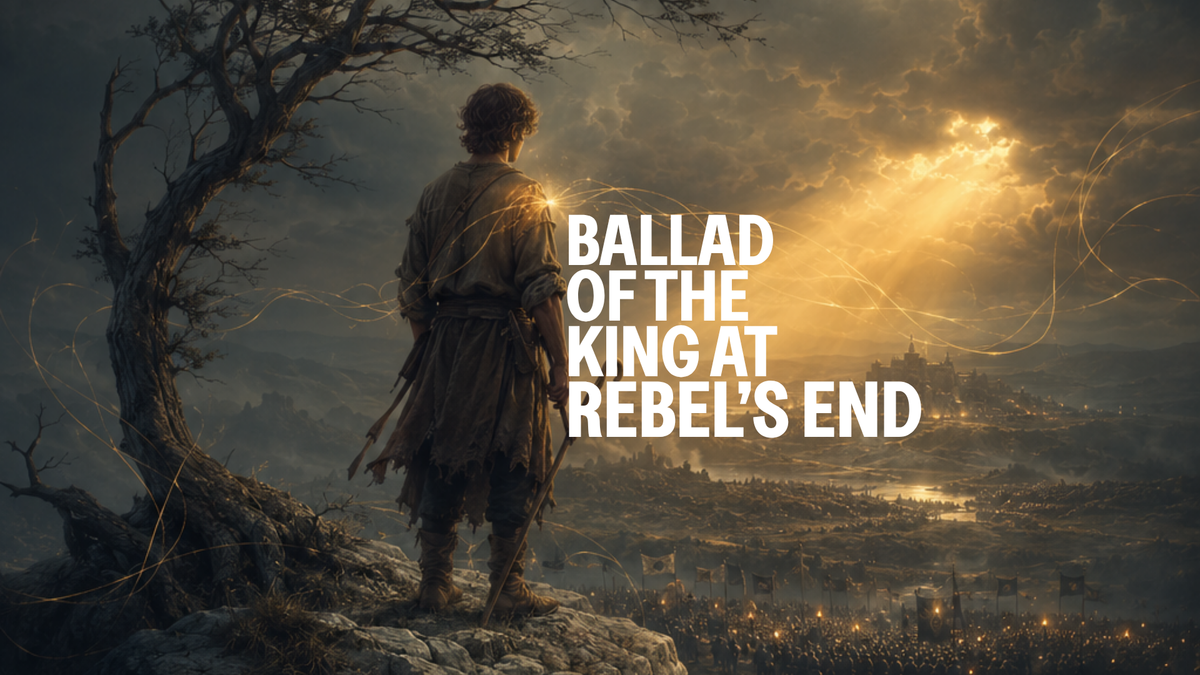
The book closes with two kings in one small land — the crowned one going cold in his northern hall, and the uncrowned one on a high place above the wilds, everything he loved lost behind him, his hand held open in the winter wind: not grasping, not yet, refusing to hurry the Song — waiting, at the beginning of the long road home.
The cycle continues.
 Tim Cleary
 Tim Cleary