Better Bible
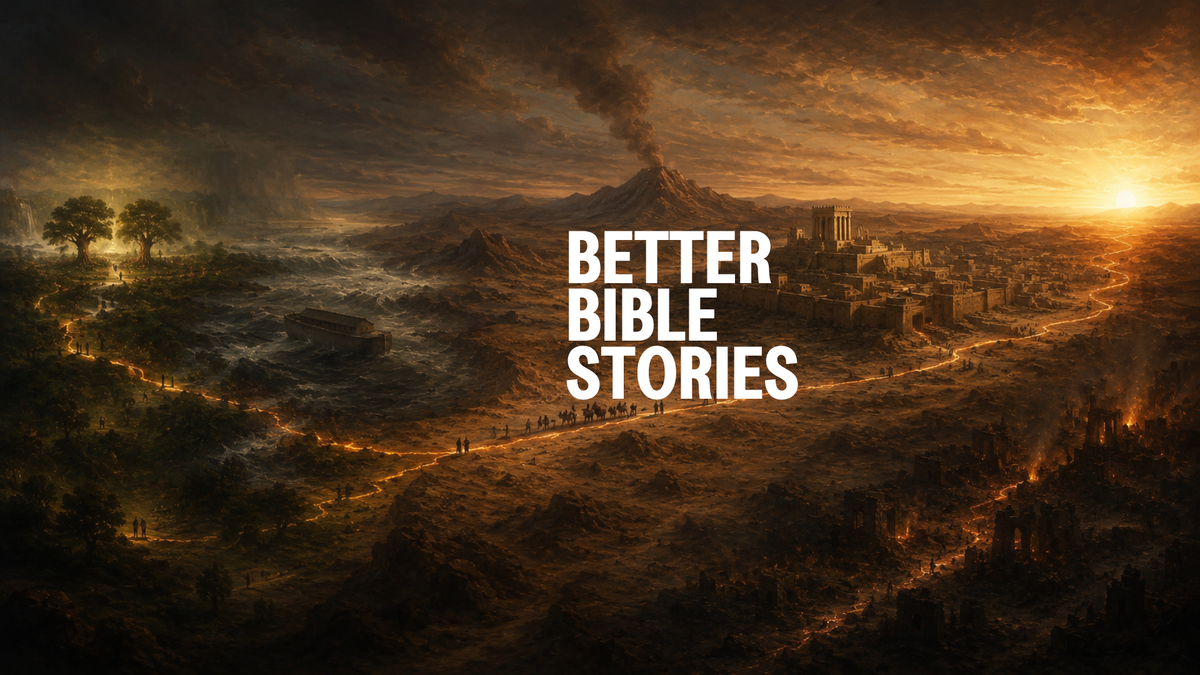
Not better than the Bible. Better than the way you've heard it told.
Somewhere along the way, Bible stories got shrunk. The strangest, darkest, most electric literature of the ancient world was cut down to flannel-board scenes and tidy morals: be brave like David, be obedient like Jonah wasn't. The violence was trimmed out, the doubt smoothed over, the weird parts quietly skipped. What was left felt like a children's book — and most people, somewhere around thirteen, outgrew it.
Here's what we think: nobody ever outgrew the Bible. They outgrew the retellings.
The real text doesn't protect you from anything. It gives you a murderer in the fourth chapter of the whole book. Heroes who lie, kings who kill for a rooftop view, prophets who sulk, a whole book where God is never mentioned by name and one where he speaks out of a whirlwind and answers no one's questions. It is honest about the world in a way almost nothing else is — and it holds together, from the first page to the last, as one story: a King, a rebellion, a promise, and a rescue that takes the long way around.
So Better Bible Stories makes you two promises.
We won't water it down. These retellings stay inside the text. Nothing invented that contradicts it, nothing hard cut out because it's uncomfortable. Where the Bible is disturbing, we let it disturb. Where it's ambiguous, we leave the ambiguity alone. You're a teenager, not a toddler — you can handle what the text actually says. It's more compelling, not less.
We won't tack on a moral. These stories weren't written to make you nicer. They were written to show you God — who he is, what he's promised, and how every strange little episode is a thread in one enormous tapestry. That's why every chapter ends with The Thread: a short section tracing how the story you just read picks up what came before and points at what's coming. Read enough of them and you start seeing it everywhere — the pattern under the pattern, the story the whole Bible is telling.
A new chapter releases every week, starting at Genesis 1 and running the length of the Old Testament — the big arcs broken into episodes, the skipped stories put back in. Each one is a ten-minute read with original artwork.
One thing to be clear about: these stories are a door, not a destination. Every chapter ends by pointing you to the passage itself, and the whole project fails if you never walk through. The retelling is here to make you look. The text is the thing worth seeing.
Start at the beginning: Chapter 1 — Let There Be.
 Tim Cleary
 Tim Cleary
 Tim Cleary
 Tim Cleary
 Tim Cleary