1 - 'Excess Baggage' - Excess Baggage
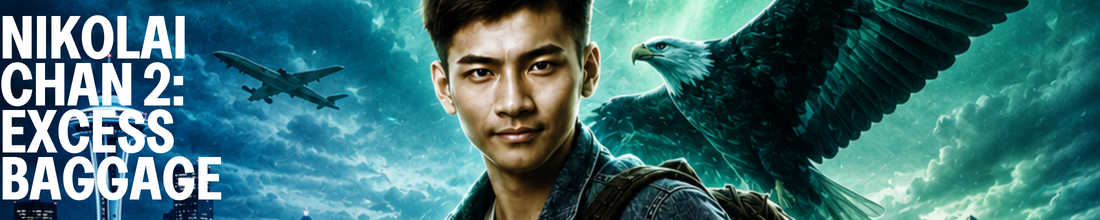
Nikolai Chan had packed for the trip four times, and it still wasn't right.
The suitcase lay open on his bed like a patient in surgery. Around it, in neat stacks that had been neater an hour ago, sat everything a thirteen-year-old could possibly need for five days in Seattle, plus several things no thirteen-year-old had ever needed anywhere: a coil of paracord, a pocket multi-tool, three flashlights of descending size, and a whistle so loud the packaging carried a warning.
"You're allowed one carry-on," Stella said from the doorway, "not one survival bunker."
"The flashlights nest inside each other. They're basically one flashlight."
"Niki."
"Fine." He took out the biggest flashlight. After a moment of reflection, he also took out the whistle, mostly because of the way his aunt was looking at it.
Six weeks had passed since what the town still called the science fair incident, and the Crawford rumor mill had polished the story smooth: a drifter with a gun, a nuclear scare caused by RavenTech cutting corners, and a local soybean rep named Wyatt Logan who had heroically saved the day and had the medal ceremony photo in the paper to prove it. Nobody in the story had a mother who was a legendary Russian assassin. Nobody's father had invented a battery that half the killers on the planet would burn a small country to own. Nobody had been dangled by his throat in a school hallway by a white-haired man called the Arctic Wolf.
Nik had gotten very good at nodding along to the polished version.
The trip was the eighth grade's doing, technically. The regional science board — impressed, apparently, by any school that could survive its own science fair — had rustled up grant money for an "educational aviation experience": five days, the Museum of Flight, a harbor tour, some pointed remarks from teachers about this being enriching. The fact that a chunk of the funding had come from RavenTech's new community-goodwill program was, in Nik's opinion, the single funniest thing to happen all fall. Elliott Kraven's PR problem was flying Nik to Seattle. His dad would have laughed for a week.
His dad. Nik's hand drifted, the way it always did, to the watch on his wrist — black face, silver rim, no buttons — and the thought underneath it, worn smooth as a river stone: Find your Dad. Three months since Adrian Chan had vanished into nowhere. Six weeks since Nik's mother — three years gone herself — had somehow slipped in and out of a locked lab to leave him a katana and a letter. He was always a better person than I was. Cherub will keep coming for you.
They hadn't come. Six weeks of nothing: no black sedans, no men in band t-shirts with silenced pistols, no red-eyed strangers ordering lo mein. Six weeks of Nik checking the street through the blinds anyway, at 5 a.m., at midnight, at 3 a.m. when the neighbor's cat set off the cellar alarm and his heart tried to exit through his ribs.
"You could still come," he said.
Stella came in and sat on the edge of the bed, next to the suitcase. She'd been up since four-thirty — he'd heard her — prepping the Sorcery for a weekend she'd now spend short-handed. "Someone has to feed this town," she said. "And Nick can't close five nights straight, his dad would arrest me." She reached over and rolled his hoodie the way he'd folded it, which was apparently wrong. "Besides. You'll have chaperones."
Something in the way she said it should have warned him.
The doorbell rang before he could ask, and when Nik came downstairs, Sergio was standing in the front hall.
The dry cleaner filled a doorway the way water fills a glass. He'd been back in town two weeks — back from what the polished version called a hunting accident and Nik privately called two bullet holes he took mostly because of me — and he moved a little slower than before, a little more carefully, like furniture that knew it had been cracked and re-glued. He was holding a plastic-wrapped bundle.
"Sergio. Hey." Nik glanced at Stella, who shrugged: he rang the bell, he's your weird friend. Officially, Sergio had taught Nik to play chess over the summer. It was the flimsiest cover story in the history of cover stories, and like all the best ones, no one questioned it because no one cared.
"You are packing," Sergio said. It wasn't a question. Very little Sergio said was a question.
"Trying. Stella has opinions about flashlights."
Stella, satisfied the visitor was Nik's problem, disappeared toward the kitchen, and Sergio set the bundle on the stairs. Shirts. Actual dry-cleaned shirts, pressed and hung, which as far as Nik knew made them the first garments Sergio's shop had processed in living memory.
"For the trip," Sergio said. "A boy who looks respectable is invisible. A boy who looks interesting is remembered." His eyes went over Nik's shoulder, up the stairs, in the direction of the suitcase, as if he could see through the floor. Maybe he could. "Roll the clothes. Do not fold. Heavy things at the wheels." A pause. "Pack nothing you cannot walk away from."
"That's the kind of packing advice they don't put in magazines."
"Magazines are for people who come home on schedule." Sergio bent — carefully, a hand braced on his side — and looked Nik level in the eye. Up close his face was the same slab it always was, but there was something underneath it that Nik had learned to read in the last six weeks, mostly across a chessboard. "Seattle is a nice city," Sergio said. "Museums. Fish market. They throw the fish. Very entertaining." Another pause, weighted. "Stay with your group, malen'kiy."
"You know something."
"I know many things. I am very old." He straightened. "Mostly I know boys who wander."
Nik lowered his voice, though Stella was banging pans two rooms away. "You said you'd give me answers. When you had them. That was six weeks ago, and you've beaten me at chess eleven times and told me exactly nothing about my mom, or the Dragon guy, or who—"
"Twelve times," Sergio said. "The game you quit is still a loss." He moved to the door with that new careful slowness, and at the threshold he stopped. For a moment Nik thought he'd get something — a crumb, a name. Instead Sergio nodded at the watch on Nik's wrist. "The airport," he said. "It will be hard for you, the airport. That is normal. It passes." And he was gone down the walk, an enormous man moving like a church door swinging shut, leaving Nik with an armful of shirts and the strong suspicion that everyone in his life knew his itinerary better than he did.
The ride to Chadron was where the trip really went sideways.
The plan, as Nik understood it: Stella drops him at the school, he takes the charter bus to Chadron with the class. The plan, as it actually unfolded: Stella got a text at 6:40, said "oh good, that's easier," and at 6:55 a familiar sedan pulled up in front of the house and Gabby Hernandez leaned out the back window.
"We got you," she said. "Bus is for kids whose dads aren't coming."
Nik's brain performed a full system reboot on the front lawn.
Gabby he had planned for. Gabby was the good part of the itinerary — five days, one time zone, zero brothers. He had thought about the plane seating chart with the strategic depth of a chess opening. What he had not planned for was the driver's window rolling down and Coach Hernandez grinning out of it in a brand-new CRAWFORD RAMS windbreaker.
"Nikolai Chan!" Coach boomed. "Defender of the innocent! Load up, we're burning daylight."
"You're—" Nik looked at Gabby. Gabby looked out the opposite window with the studied innocence of someone who had absolutely known and absolutely not mentioned it. "You're coming? To Seattle?"
"Chaperone," Coach said, savoring the word. "Eight days ago Mrs. Petersen's hip says no more airplanes, and who steps up? Who has experience keeping teenagers alive in a major West Coast city?" He slapped the outside of the car door. "This guy."
"Kill me," Gabby said quietly, to the window.
Nik put his suitcase in the trunk next to Coach's, which was larger, and got in. The whole way to Chadron — twenty-five minutes that lasted, by the clock in Nik's head, roughly six years — Coach laid out the rules of engagement: buddy system, ten p.m. curfew, no separate tables at dinner, and a seating arrangement on the plane that he described, twice, as "boy, aisle, me."
Gabby mouthed sorry somewhere around mile ten. Her eyes were doing the thing where they went greener when she was trying not to laugh, which made it very hard for Nik to stay bothered about anything, which was its own kind of problem.
Then they walked into the Chadron airport, and the bottom fell out of Nik's morning.
It was nothing. It was a regional airport the size of a grocery store, full of families and duffel bags and a man asleep across three chairs. It was forty eighth-graders in matching yellow lanyards being herded by Mr. Bilkins toward the check-in counter. It was fine.
It was the smell — coffee and floor polish. It was the flight board flipping its letters. It was, when the class funneled past the stairwell, the view straight down into baggage claim: the carousels, the trapdoor with its hanging strips of gray plastic, the newspaper stand.
The last time Nikolai Chan stood in this building, a man with a shock of white hair and a dead eye had closed one huge hand around his neck, right down there, by carousel one, and smiled while Nik's feet dangled. You are like cockroach, the Arctic Wolf had said, almost fondly. Hard to kill and turn up in unexpected places. Nik had escaped him with a stomped foot and a stolen-gun bluff and the kind of luck you don't get twice. That same afternoon a man he'd never met had chased Wyatt around long-term parking with a pistol, and a voice on a stolen radio — smooth, patient, wearing its American accent like a tailored suit — had told Nik, Your mother sends her love.
The Butcher. The man in the purple suit, who had walked out of this airport with an armed killer past four security guards, and later put a knife into Nik's back like he was signing something. The man whose blood had come back off the wrecked Panther with a dead man's name on it — Mikhail Orlov, a Russian dignitary twenty years in the grave — which meant even his DNA was a lie. The man some part of Nik's brainstem now saw everywhere: in crowds, in cars, in the coat rack at the Sorgery at closing time.
They had all just — stopped. After the science fair, Cherub had folded its hand and vanished, and every adult in Nik's tiny circle of people-who-knew seemed to think that was good news. Nik knew better. He'd read the letter a hundred times. His mother didn't write Cherub will keep coming for you to be dramatic. His mother had never once in her life been dramatic on paper.
"Hey." Gabby's shoulder bumped his. She'd tracked his stare down the stairwell to the carousels and misread it exactly as well as he could have hoped. "It's a school trip. Statistically the most dangerous thing this week is Bilkins driving the rental van."
"Right," Nik said.
"You've flown before?"
"Never left Nebraska."
Her eyebrows went up, and the smile that came with them was the real one, not the teasing one. "Then quit staring at baggage claim, Chan. That's the boring end of an airport. Come on — window seat's mine, but I'll let you look."
She hooked his sleeve and towed him toward security, and Nik let her, and for a second — lanyard on his neck, boarding pass in his teeth, his best friend's sister laughing at him in the gray morning light — the whole thing felt exactly like what it was pretending to be. A field trip. A normal kid, going somewhere normal, with people he liked.
At the front of the line, Coach was loudly explaining to a TSA agent that he used to be law enforcement himself, professional courtesy, no he did not need to take off the windbreaker, yes okay he would take off the windbreaker.
Nik laughed. He actually laughed.
Then his eyes did the sweep — the one his mother had drilled into him before he was old enough to know it was a drill, corners, exits, hands — and snagged, for a half heartbeat, on the far end of the terminal: a tall figure by the vending machines, dark hair, standing very still, in a suit the color of a fresh bruise.
The crowd shifted. A family with a stroller crossed the gap.
When it cleared, there was no one there at all.