Better Bible - Chapter 6 - The Bow in the Clouds
Arc 1: Beginnings · Genesis 8:20–9:29
The world is empty and washed clean and completely silent, and the first thing the man who survived it does is build an altar.
Not a house. Not a field. An altar, first, before anything else - smoke rising off it into a sky that spent a hundred and fifty days trying to erase every living thing under it. And somewhere above that smoke, watching it climb, God is about to make a promise he has never made before, to a world that has just proven it was capable of the worst thing he could imagine.
The Story
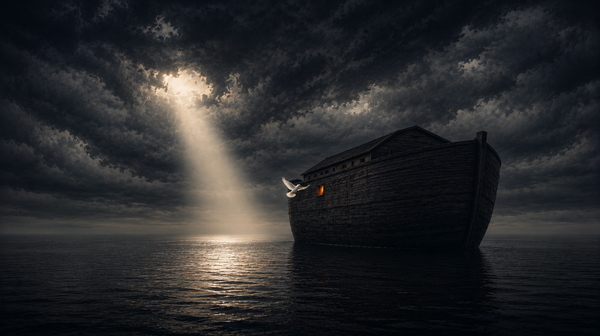
Noah steps off the ark onto ground that used to be a world and takes some of every clean animal and bird and offers them up as a burnt offering. And the LORD, the text says with startling tenderness, smells the pleasing aroma, and says in his heart - not to Noah yet, just to himself, the way you'd resolve something privately before you announce it - I will never again curse the ground because of man, even though the inclination of his heart is evil from his youth. I will never again destroy every living thing as I have done. As long as the earth remains, seedtime and harvest, cold and heat, summer and winter, day and night, will not cease.
Notice what that promise is not. It is not a claim that people have changed. He says the opposite - evil from their youth, same as before the flood, same as it will always be. The promise isn't earned by their improvement. It's granted anyway. The ground held in place by nothing but God's own decision to hold it there, whatever the people standing on it turn out to be like.
Then he speaks to Noah directly, and the words are the same words spoken over the first humans in the first garden, handed forward now to the second beginning of the world: be fruitful, multiply, fill the earth. But something has shifted since the garden. Now every animal will live in dread of these image-bearing humans; now every moving thing is given for food, where before there was only fruit and grain. One line only holds them back - do not eat flesh with its life, its blood, still in it. Blood means something now. Watch that.
Because the next thing God says explains why. For your lifeblood I will require a reckoning... whoever sheds the blood of man, by man shall his blood be shed, for God made man in his own image. Remember that phrase from the very first chapter of this whole series - every human being, a living statue planted in the world to mark whose it is. Cain's murder of his brother is still the freshest wound in this story, and here, finally, is the answer to it: a law, built directly on the dignity of the image, that makes shedding human blood the one crime this new world will treat as an assault on God himself.
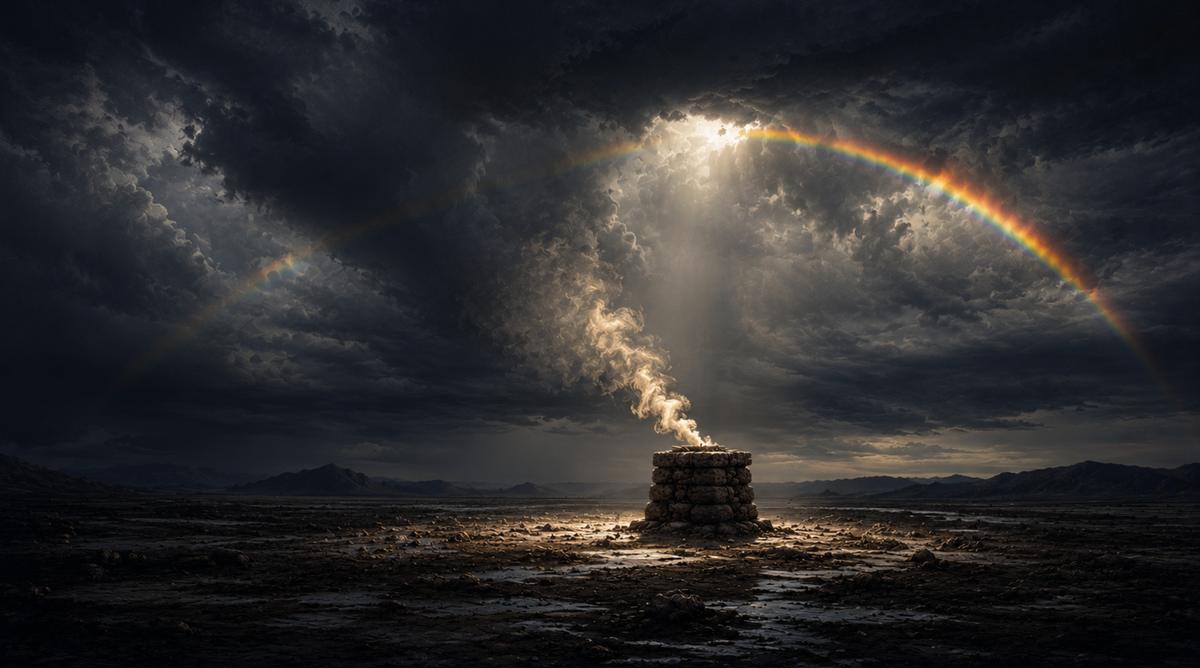
And then the covenant - not with Noah alone, but with his children, and with every living creature, and with the earth itself, for every generation still to come: never again will the waters become a flood to destroy all flesh. As a sign, God sets his bow in the clouds.
A bow. Think about what a bow actually is in the ancient world before you read past that word - a weapon, strung and aimed, the tool a warrior reaches for when judgment is coming. And here it is, hung up in the clouds after the storm, unstrung, curved away from the earth and pointed instead at the sky, a weapon of war turned into decoration on the very sky it once rained destruction from. When I see the bow in the cloud, I will remember my covenant. God hangs up his own weapon and calls it a promise. It is not humanity remembering to behave. It is God remembering to hold back - a covenant that runs on his restraint, not their record.
It should be the end of the story. A second Adam, a second commission, a covenant that will hold no matter how bad humanity gets. But the chapter isn't finished, and what comes next is the exact same pattern the very first Adam wrote, played out again almost beat for beat.
Noah, a man of the soil, plants a vineyard. He drinks its wine, and he gets drunk, and he ends up lying uncovered inside his own tent - naked, the very word this whole series has been circling since the garden, except this time there is no serpent standing nearby to blame. His youngest son, Ham, the father of Canaan, sees his father exposed like that and goes out and tells his two brothers, rather than quietly covering him. Shem and Japheth do what their brother didn't: they take a garment, walk in backward together so as not to look, and lay it over their father without ever seeing what Ham made sure to look at and describe.
When Noah wakes and understands what happened, he pronounces a curse - not on Ham directly, but on Ham's son Canaan: lowest of slaves shall he be to his brothers. Blessing, then, on Shem, and on Japheth, that he would be enlarged and would dwell in the tents of Shem, with Canaan still serving them both.
This is one of the passages we have to slow down on, because history has done ugly things with it. For centuries this curse on Canaan was twisted - with no support from the actual text - into a justification for enslaving people, on the false premise that Ham was somehow the ancestor of those peoples and this curse marked their descendants for servitude. That reading is not in Genesis. It was invented later, by people who needed a Bible verse to defend something evil they had already decided to do. What the text is actually doing, in its own moment, is setting up a much later part of this story: Canaan's descendants are the Canaanite peoples Israel will eventually enter the land alongside - and this old family wound explains, generations ahead, why that meeting will be so fraught. It is family history, not a verdict on race.
What the story actually wants you to notice, underneath all of it, is simpler and sadder: a man saved through judgment to start the world over, given the same blessing Adam was given, falls the exact same way Adam fell - exposed, ashamed, undone by something in a garden of his own planting. The flood scoured away every other human being on earth and it still couldn't scour this out of the one man it kept alive. Whatever was wrong before the water came is still as wrong after it recedes. It just has a clean field to go wrong in again.
Noah lives three hundred and fifty years after the flood and dies at nine hundred and fifty. The bow stays in the sky. The question the whole chapter leaves hanging is the one this entire series is going to keep asking, generation after generation, new Adam after new Adam: who, finally, won't fall?
The Thread
Every new Adam fails. Adam fell in a garden; Noah, blessed with Adam's own words, falls in a vineyard he planted himself. Watch for this shape to recur - every fresh start this story offers a flawed rescuer will end the same way, until the pattern itself becomes the question the whole Bible is asking.
A weapon turned into a promise. The bow hung unstrung in the clouds, aimed away from the earth, is the first time in this story that judgment gets disarmed and displayed instead of used. It won't be the last image of wrath absorbed rather than unleashed.
Blood and the image. The law protecting human life by appeal to the divine image closes the wound Cain opened - and plants the reasoning underneath everything the rest of Scripture will say about human dignity and its violation.
Read It Yourself
Genesis 8:20–9:29