Eagles aren't Middle Earth's Uber
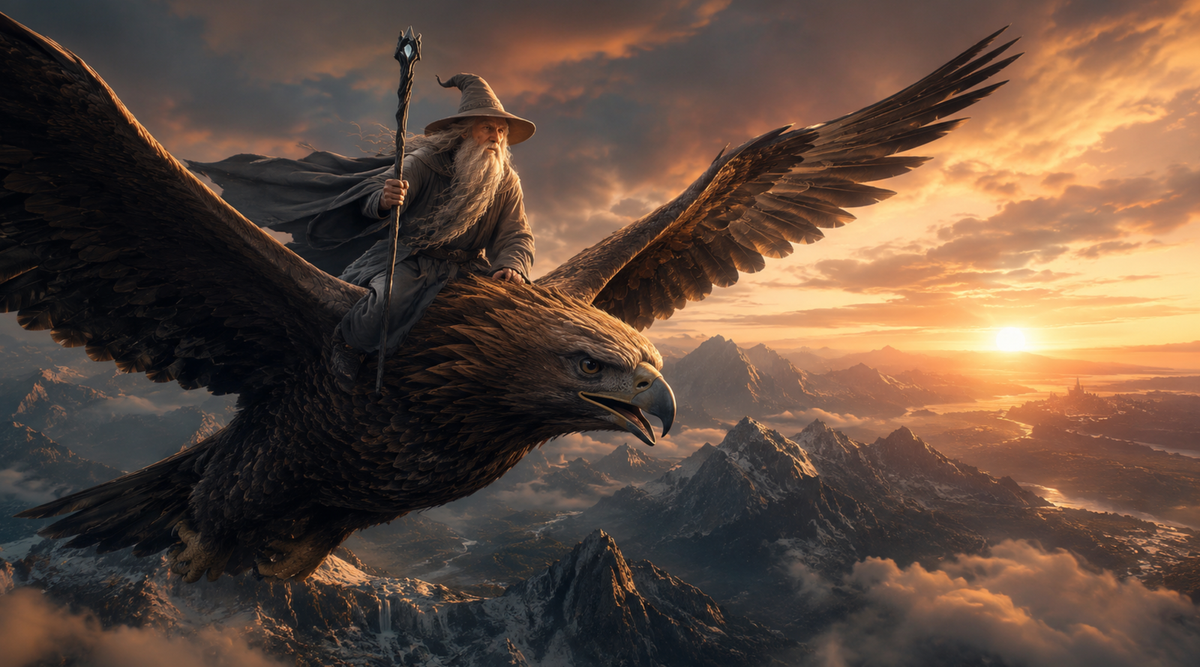
Every reader of The Hobbit and The Lord of the Rings eventually asks the same question: if the Great Eagles could swoop in and save the day at Weathertop-adjacent cliffs, the Misty Mountains, and even pluck Frodo and Sam off the slopes of Mount Doom itself - why didn't anyone just fly the Ring there in the first place? The answer lies less in plot convenience than in what the Eagles actually are within Tolkien's cosmology, and in the brutal tactical reality of Mordor's skies.
The Great Eagles are not oversized birds of prey. In Tolkien's legendarium, they were made by Manwë, King of the Valar and Lord of the Winds, as his eyes and instruments in Middle-earth. Their ancestor, Thorondor, fought Morgoth himself in the First Age. Gwaihir the Windlord and his kin in The Hobbit and The Lord of the Rings are diminished descendants of that same line - still semi-divine beings with will, pride, and their own agenda, not tame mounts.
This matters enormously. The Eagles help because Gandalf (himself a Maia, an agent of the same power that made them) asks them to, and because it serves their own interest in resisting Sauron. They are allies, occasionally, not a taxi service on retainer. Manwë does not commit his messengers lightly, and the Eagles themselves would never accept being reduced to living transport for a piece of cargo, however important.
The Real Problem: Sauron's Eyes Are in the Sky
The strategic reason is more concrete. By the time the Fellowship sets out, Sauron's power is concentrated on watching for exactly this kind of move. His Nazgûl, mounted on their monstrous flying steeds, patrol the air over Mordor and its approaches. A pair of giant eagles carrying passengers toward the one mountain Sauron watches more closely than anywhere else in Middle-earth would be spotted almost immediately - there is nowhere to hide in open sky, and eagles are large, slow enough to be run down, and utterly conspicuous against the horizon.
The entire strategy of the Ring's destruction depends on the opposite of a direct assault: stealth, obscurity, and the assumption that Sauron would never imagine his enemies trying to destroy the Ring rather than use it against him. Two small hobbits creeping through Mordor's back country are easy to overlook. A Windlord-class Eagle on a beeline for Orodruin is not. Flying the Ring in announces the one thing the whole plan is built on hiding.
The Eagles also aren't a standing army. There are only a handful of named Great Eagles in the story, and Sauron's forces are vast; a small number of Eagles attempting to punch through Mordor's airspace would be met by the Nazgûl's flying mounts, and possibly worse, with no real chance of winning that fight in the open sky. Every time the Eagles do intervene in the books, it's a rescue at the edges - snatching people away from a battlefield already won or lost, or lifting the injured out after the danger has passed. That is a fundamentally different task from escorting the single most dangerous object in the world through hundreds of miles of hostile, watched territory to its most heavily defended point.
So Why Could They Rescue Frodo and Sam at the End?
This is the detail that makes the "why not just fly there" question feel so obvious - and also answers it. By the time Gwaihir and his companions arrive at the Cracks of Doom, the Ring has already been destroyed. Sauron's power has collapsed, the Nazgûl have been unmade, and Mordor's defenses are in chaos. The sky that was lethal an hour earlier is suddenly navigable. The Eagles could fly in and out freely precisely because the thing that made Mordor's airspace deadly was already gone. Their late rescue is proof of the danger they'd have flown into earlier, not evidence it was never there.
Tolkien was also, as a storyteller, uninterested in a version of this tale where the hardest problem in Middle-earth is solved by convenient air travel. The entire moral architecture of the story - small, unlikely people succeeding through endurance rather than power - depends on the journey being made on foot, in secret, by those least likely to be noticed or corrupted. The Eagles exist to rescue the weary at the right moment, not to shortcut the theme of the whole book.
The Bottom Line
The Great Eagles were never a missed logistical solution. They were proud, semi-divine beings who intervened selectively and at great personal risk, in a world where the skies over Mordor were the most heavily watched real estate in Middle-earth. Flying the Ring there directly wouldn't have been a clever shortcut - it would have been the fastest possible way to lose the War of the Ring.