Better Bible - Chapter 4 - Sin Is Crouching

Arc 1: Beginnings · Genesis 4
Two altars. Two brothers. Two piles of smoke rising into the same morning sky - and one of them bends, and one of them doesn't, and the brother left standing in the smoke that won't rise is not the one you'd expect to be angry.
He is the one still standing outside the garden gate. He has every reason already. This is just the first new one.
The Story
Life goes on east of Eden, which is the whole quiet horror of the last chapter's ending - that it doesn't stop the world, only exiles it. Eve conceives and bears a son. I have gotten a man, with the help of the LORD, she says, and there's something almost defiant in it - the woman just told she'll bear children in pain names her firstborn like a small victory anyway. She names him Cain. Then Abel, his brother.
They grow up into two kinds of work, and both kinds are honest work - Abel keeping sheep, Cain tilling the ground his father was formed from and his father was cursed through. In the course of time, both brothers bring an offering to the LORD. Cain brings some of the fruit of the ground. Abel brings from the firstborn of his flock - and the fat portions specifically, the best parts, the part a flock owner could have kept for himself and didn't.
The text doesn't explain the difference in so many words. It doesn't have to. One brother is described giving the best of what he has, specifically, by name. The other is just described giving some. And the LORD looks with favour on Abel and his offering, and on Cain and his offering he does not.
Cain is furious. His face falls - the same word, almost, that will describe an empire falling later in this story, used here for the first time on a single human face. And God comes to him, the way he came looking in the garden, not to condemn but to ask:
Why are you angry? Why has your face fallen? If you do what is right, will you not be accepted? But if you do not, sin is crouching at the door. Its desire is for you, but you must rule over it.
Listen to the picture. Sin isn't a rule Cain might break. It's an animal, crouched low at his door the way a predator crouches before it springs, wanting him the exact same way - the text uses the exact same words - that the woman's desire was said to bend toward her husband two chapters ago. Sin wants to own Cain the way a curse wants to own a marriage. God doesn't tell him it's impossible to resist. He tells him to rule it, the same word given to the very first humans over the animals of the garden. The choice is still open. The door hasn't shut.
Cain does not rule it.
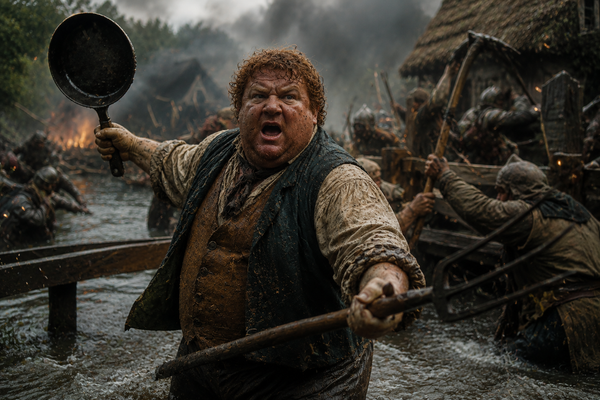
He says something to his brother Abel - the text doesn't record the words, only that they went out to the field together - and there, away from anyone else in the whole world who could have stopped it, Cain rises up against his brother and kills him.
The first murder in human history is a brother killing a brother over an act of worship that didn't go the way he wanted.
And then the LORD is asking questions again, the same gentle, terrible pattern as the garden. Where is your brother Abel? Not because he doesn't know. Because the question is still a door held open, one more time, for a man to walk through and tell the truth.
Cain slams it shut instead. I don't know, he says. Am I my brother's keeper?
Keeper. The very word given to the first man for the very first job in the world - to work the garden and keep it, guard it, watch over it like a priest over something entrusted to him. Cain reaches for that word now, sarcastically, to deny that he owed his own brother anything at all. The man refused to guard a person is the son of the man who was told to guard a garden. Something has gotten so much worse in one generation.
What have you done? God says. Listen - your brother's blood is crying out to me from the ground.
The ground again. Always the ground in this family's story - formed from it, placed to work it, cursed through it, and now soaked with the first blood ever spilled onto it by a human hand, and the ground itself, in the poetry of the text, has a voice, and it is screaming.
The curse that follows lands exactly where the crime was committed. Cursed from the ground that opened its mouth to receive your brother's blood from your hand. When you work the ground, it will no longer yield its strength to you. You will be a restless wanderer on the earth. Adam's curse was that the ground would fight him. Cain's is worse - the ground he's cursed through won't even fight him anymore. It will simply refuse to answer him at all, and he'll never be able to stay anywhere long enough to find out.
Cain's answer is not repentance. It's arithmetic. My punishment is too great to bear. You're driving me from the land and from your presence, and I'll be a restless wanderer, and whoever finds me will kill me. He's afraid of exactly what he just did to Abel, done back to him.
And here is the strangest turn in the whole chapter: God protects him anyway. He puts a mark on Cain so that no one who finds him will kill him, and pronounces a sevenfold vengeance on anyone who tries. The first murderer in the world walks away from his brother's blood still crying from the ground, marked not for death but for safety - mercy handed to a man who showed none, because apparently that is simply the kind of God this is.
Cain goes out from the LORD's presence and settles in the land of Nod - the word means wandering, a country named for exactly what he's sentenced to - east of Eden. East again. Every step this family takes is further from the gate the cherubim are guarding.
And then, of all things, Cain builds a city.
A wanderer, cursed off the land, raises a wall around a permanent place and names it after his son Enoch — the first city in the Bible, built by the first murderer, as if a man who can't be settled by God is determined to settle himself. His line runs fast after that: Irad, Mehujael, Methushael, Lamech — and in that line, remarkably, civilization accelerates. Lamech takes two wives, the first polygamy the text records, and their sons found entire ways of life: Jabal, father of everyone who lives in tents and keeps livestock; Jubal, father of everyone who plays the lyre and the pipe; Tubal-Cain, who forges bronze and iron. Music. Industry. Architecture. All of it, springing up out of the cursed and murderous line of Cain, because this is a text too honest to pretend that human giftedness and human violence grow in separate soil.
They don't. Here's Lamech's proof, sung to his own wives like a boast set to music: I have killed a man for wounding me, a young man for striking me. If Cain is avenged sevenfold, Lamech seventy-seven times. God's mercy on Cain - a shield against vengeance - has been picked up by his own descendant and forged into a threat. Seven becomes seventy-seven. The crouching thing at the door has gotten up and is walking around loose in broad daylight, and it is very good at music.
But the chapter doesn't end on Lamech.
Adam and Eve have another son. Eve names him Seth - appointed - because, she says, God has appointed for me another child in place of Abel, since Cain killed him. And Seth has a son, Enosh, and at that point, the text says, quietly, almost like an afterthought against everything Lamech has just sung: people began to call on the name of the LORD.
Two lines, moving in opposite directions out of the same family. One is building cities and writing songs about revenge. The other has just started praying. The rest of this story is going to spend a very long time asking which one wins.
The Thread
East of Eden, again. Adam and Eve were sent east once. Now Cain wanders further east still, into a land named for wandering. The direction keeps repeating because the problem keeps repeating - every generation finds a new way to walk further from the gate.
A keeper who wouldn't keep. The man given a garden to work and keep has a son who throws that same word back at God as an excuse. Watch for it: the whole rest of Scripture is one long argument that yes, you are your brother's keeper - culminating in someone who keeps that promise all the way to a cross.
Blood that cries, and blood that speaks better. Abel's blood cries out from the ground for justice - the first blood spilled, demanding an answer. Centuries later, the book of Hebrews will name another blood, shed the same way, crying out something different: not vengeance, but a better word. The whole distance between those two cries is the distance this series is walking.
Two lines from one family. Cain's violent, gifted, city-building line and Seth's quiet, praying line split humanity here for the first time - the seed of the serpent and the seed of the woman, promised back in the last chapter, now showing up as two actual family trees.
Read It Yourself
Genesis 4