Better Bible - Chapter 5 - The Unmaking
Arc 1: Beginnings · Genesis 6:1–8:19
The door doesn't close by a human hand.
Noah is already inside. His sons are already inside. Every animal that is going to fit through that door has already gone through it, two by two, seven by seven, and the rain hasn't started yet - the sky is still just sitting there, waiting, the way it's been waiting for a hundred years. And then the text says one thing that stops a reader cold: the LORD shut him in.
Not Noah. Not a servant with a plank and a hammer. God himself, closing the door on the only family and the only breath of every kind of creature that is about to survive what's coming.
The Story
Something strange happens in the world before the flood, and the text refuses to explain it fully - the sons of God and the daughters of man, and children born of that meeting called the Nephilim, men of renown, giants in the land. Readers have argued for thousands of years over exactly who "the sons of God" were, and the text itself never stops to clarify - it says the strange thing once, plainly, and moves on, the way you'd mention a crack in a foundation and then get straight to the part where the whole house comes down. Whatever exactly is meant by it, the point the narrator actually cares about follows immediately: the earth is filling up with something that has gone badly, permanently wrong, and it isn't contained to one family or one city anymore. It's everywhere.
The LORD saw that the wickedness of man was great in the earth, and that every intention of the thoughts of his heart was only evil continually.
Not evil sometimes. Not evil in this one nation and not another. Only evil, and continually. And the response the text records isn't distant or clinical. God is grieved. His heart is troubled. He is described the way you'd describe someone standing over something they made with their own hands, watching it ruin itself, and wishing - in language this blunt - that he had never made it. I am sorry that I have made them, he says, and decides to wipe them from the face of the ground: people, animals, creeping things, birds. Everything that breathes.
Everything, except one family.
Noah found favour in the eyes of the LORD. Not because he earned an exemption - the text is careful to say the finding came first, favour before performance - but the man who receives that favour turns out to be worth the description that follows it: righteous, blameless in his generation, a man who walked with God, the same phrase that once described evenings in the garden, before anyone had reason to hide from the sound of God moving nearby.
The earth, God tells Noah, is filled with violence because of all flesh - not one bloodline, not one city, everyone - and he has decided to bring the ground itself down with the people who ruined it. So he gives Noah a set of instructions with the specificity of a blueprint: a boat of gopher wood, sealed inside and out with pitch, three decks, a door in its side, built to a length and width and height that leave no doubt this is meant to survive something enormous. Into it: Noah's family, and two of every kind of living creature, male and female, to keep them alive - later refined to sevens of the clean animals, so that something will be left over for sacrifice on the other side of what's coming. Food enough, for however long it takes.
Noah did this; he did all that God commanded him.
Then the waters.
Watch what actually happens when the flood comes, because the language reaches back three chapters to the very beginning of everything. On day two of creation, God split the waters - some above, some below, a dome holding them apart so a world could exist in the gap between them. Now: all the fountains of the great deep burst open, and the windows of the heavens were opened. The waters above and the waters below, held apart since the first week of the world, come back together. This isn't only a storm. It's creation running in reverse - the separating undone, the boundaries taken back down, the world returned to the very tohu wavohu, the formless deep, it started as.
Forty days and nights of rain. The fountains of the deep pouring up from below at the same time. The water lifts the ark off the ground and keeps rising - over the hills, over the mountains, until the text says even the highest peaks are covered by more than twenty feet of water, and everything that had the breath of life in its nostrils, everything on dry land, dies. Everyone and everything the world had been filled with in the days of that first temple-building week, undone in the same span it took to build it.
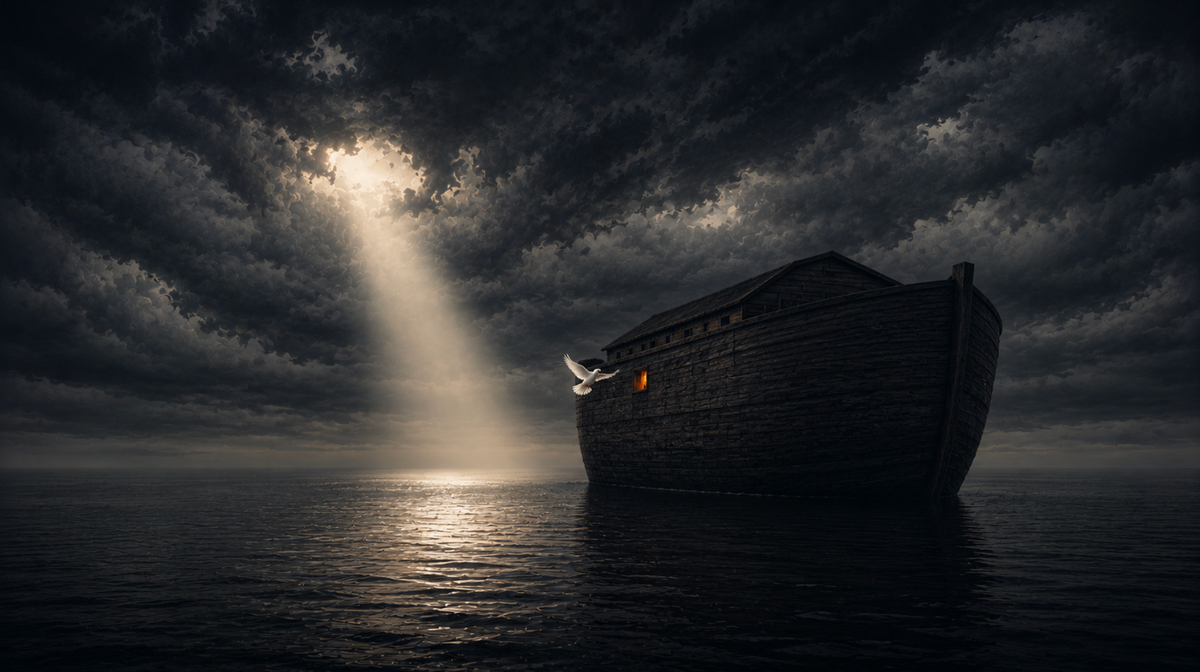
Only the ark rides on top of the ruin. One sealed room, floating on a world gone back to formless water, holding inside it every kind of living thing that still has a future - which is, when you say it plainly, a very small sanctuary carrying the whole of creation's next chapter through the middle of its own funeral.
The water prevails a hundred and fifty days. And then - a single line, easy to read past, carrying the whole hinge of the story - God remembered Noah.
He sends a wind over the earth, the same word breathed over the water in the very first verse of this whole series, and the waters begin to go down. The fountains close. The rain stops. Slowly, in stages the text tracks month by month like a countdown running backward, mountaintops break the surface again, and the ark settles onto the mountains of Ararat.
Noah waits. He opens a window and sends out a raven, which just goes back and forth, back and forth, finding nowhere to land in a world still mostly water. Then a dove - smaller, gentler, and this one comes back to him, because she can find no place to rest her foot in all that ruin, and he reaches out his hand and takes her back into the ark. Seven days later, he sends her again. This time she comes back in the evening with a freshly plucked olive leaf in her beak, and there is no line in this whole flood story more quietly enormous than that one small green leaf. Something is growing again, somewhere out there. Seven more days, and the third time he sends her out, she doesn't come back at all.
Noah removes the covering of the ark and looks out, and the ground is dry.
And then God speaks to Noah exactly the way he spoke on the sixth day of the very first chapter of this whole series: go out, you and your family and every living thing with you, and be fruitful and multiply and fill the earth. Word for word, almost, the commission handed to the very first humans in the very first garden. The old world drowned in the wickedness it filled itself with. And here is Noah, stepping out of a floating sanctuary onto ground that has been scoured back down to bare rock and new mud, handed the same job Adam was handed at the beginning of everything.
A second Adam. A second beginning. The door that God himself shut is the same door he's about to open.
The Thread
The ark as a floating sanctuary. A small sealed space, built to precise divine measurements, carrying the future of creation safely through judgment - this is what a tabernacle will be, and later a temple, and this pattern will keep repeating: a place of safety inside the wrath the whole world outside it is receiving.
New creation out of water. Waters that once destroyed become, before this chapter ends, waters a whole new world rises out of - the same shape Exodus will use at the Red Sea, Joshua will use at the Jordan, and the New Testament will use for baptism: judgment and rescue riding through the very same water.
A second Adam, a second commission. "Be fruitful and multiply and fill the earth" isn't new language - it's the exact charge given at creation, handed now to Noah as if the whole project is starting over. Watch what he does with it. Every "new Adam" this series will introduce is being tested against the same question: will this one succeed where the first one didn't?
Read It Yourself
Genesis 6:1–8:19