Better Bible - Chapter 2 - The Garden
Arc 1: Beginnings · Genesis 2
The animals keep coming.
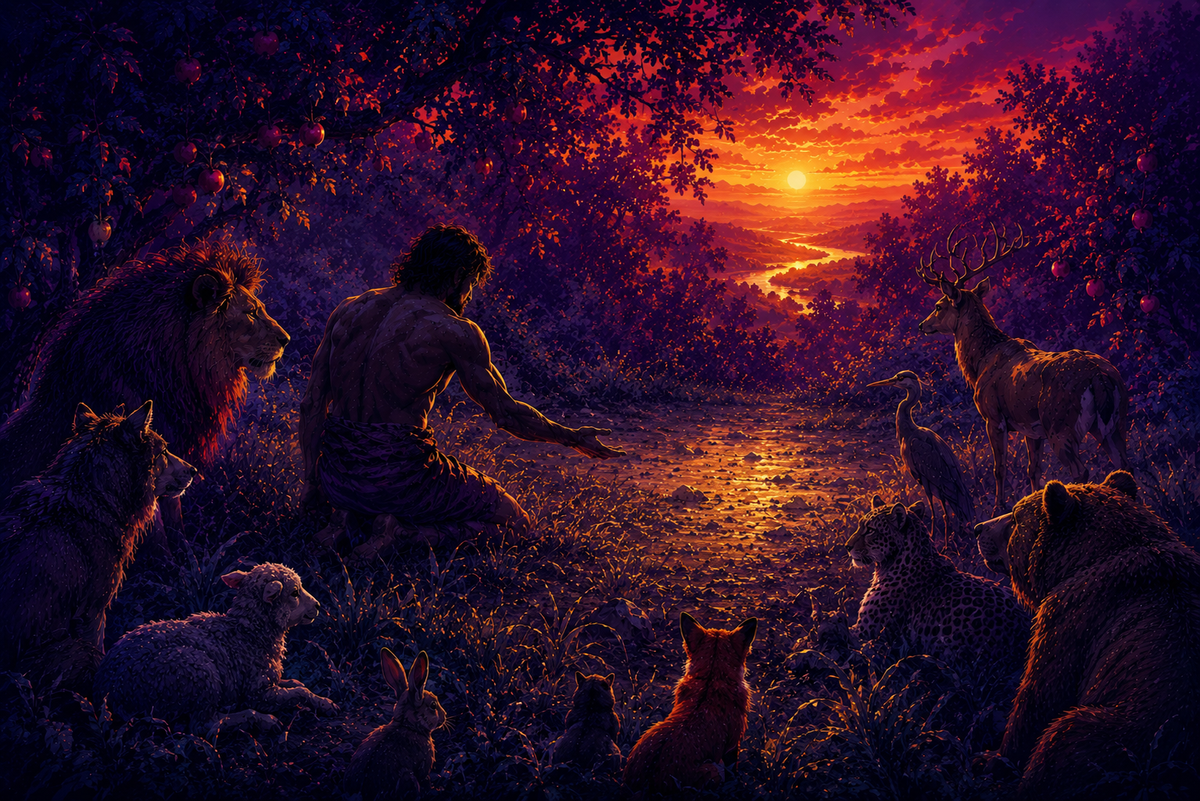
Lion, then lioness. Ox. Sparrow. Something with too many legs that startles when the man laughs — the first laugh in the history of the world, spent on a bug. One by one they file past him under the fruit trees, and one by one he names them, and something is missing. He has no word for it yet. He only knows that among the ostrich and the antelope and the creature he has just called goat, there is a shape he keeps looking for, and it never comes.
The Story
The first chapter told this story from a height — a voice over the dark water, days stacking like courses of a temple wall. This chapter climbs back down. Same six days, same world, but now the lens is a garden, and the camera is a foot off the ground.
Before there is rain, there is a problem: no rain, and no one to work the ground. The earth is dry and unplanted, waiting on two things at once — water and a farmer. God solves the first with a mist that rises and waters the whole face of the soil. He solves the second by kneeling.
That's the detail the text won't let go of. Not a decree this time — no let there be. God scoops up dust from the very ground he means to plant, shapes it with his own hands the way a potter shapes clay, and then does something no other line in the chapter does: he leans in close and breathes. Not a word flung from a distance. Breath, mouth to whatever this shaped dust now is, filling it from the inside.
And the dust gets up.
The Hebrew is doing something the English can't quite hold on to: the man is adam, formed from the adamah, the ground — a pun built into his very name, the way "human" and "humus" nearly rhyme in English if you squint. He is dirt with breath in it. That is the whole of human dignity and the whole of human humility folded into one name, and Scripture will keep circling back to it: dust you are, and to dust you will return — but for now, breath. For now, a living being, standing up out of the field that made him.
God plants a garden eastward, in a place called Eden, and puts the man there. It's not the whole world — the whole world was finished back in the last chapter, formed and filled and called very good. This is something more particular. A garden inside the world. Trees the eye wants to look at and the mouth wants to eat from, growing thick around two trees standing apart from the rest: the tree of life, and the tree of the knowledge of good and evil, planted in the middle where no one entering the garden could miss them. A river flows out of Eden to water it, then splits into four, and the text — usually so quick to move — slows down here to list them by name and describe what's found along their banks: gold, and it says the gold of that land is good, and resin, and precious stone. It's an odd thing to mention in a story that hasn't cared about mineral deposits until now. Remember it. It will matter again.
Then the job description. God takes the man and puts him in the garden to work it and to keep it. Two verbs, ordinary enough on a farm — till the soil, guard the fence. But they are not random verbs. In all the places these two words appear together again in the rest of the Bible, they describe one thing: what priests do in a sanctuary. Serve it. Guard it. The man hasn't just been handed a garden plot. He's been installed as a priest in a green temple, and the trees are its furniture.
With the job comes the one rule the whole garden has: eat freely, from anything, from every tree without limit — except one. From the tree of the knowledge of good and evil you must not eat, for on the day you eat from it, you will surely die. Notice what the rule is not. It is not a maze of restrictions. Out of an entire garden it forbids exactly one tree, and even that comes wrapped in abundance — eat freely, it says, before it says the one thing you may not. A single boundary, set at the center of a world of yes, with a warning attached that the man is trusted to hear and keep.
Then a sentence that stops the whole story cold, because it breaks a pattern the reader has just spent a full chapter learning to expect. Six times the last chapter said good. Six times, building to very good. And now, for the first time in the story of everything, God looks at something he has made and says the opposite.
It is not good for the man to be alone.
Not good — inside a story that has trained its reader to expect nothing but good. The man stands in a finished, very-good world, priest of a garden temple, and something is still missing, and God says so before the man even has language to say it himself. So God brings the animals to him, the whole procession — livestock, birds, every wild thing — and lets him name them one by one, the same royal act as the naming of light and dark and sky back on day one, kings and queens exercising the authority handed to them at creation. Among them all, not one is found to be what the text calls an ezer kenegdo — a helper who stands opposite him, a match, a counterpart strong enough to complete what he cannot do alone. The word for helper is the same word Scripture will later use for God himself, coming to Israel's rescue. It is not a lesser word. It is the word for exactly the kind of help that only an equal can give.
So God does again what he did at the beginning of the man — not a word flung from a distance, but hands, and closeness. He puts the man into a deep sleep, opens his side, takes what the old translations call a rib and newer ones render as a whole side of him, and builds it — the same verb used later for building cities and temples — into a woman. He brings her to the man the way a father brings a bride to a wedding, and the man, seeing her, breaks into the first poetry anyone has ever spoken:
This, finally. Bone of my bone. Flesh of my flesh.
He names her the way he named the animals, but this time the name is a mirror — ishah, because she was taken out of ish — man and woman sharing a name the way nothing else in the garden shared his name, because nothing else in the garden was taken out of his own side. The text steps back to explain what this means for every marriage after this one: a man leaves his father and mother and holds fast to his wife, and the two become one flesh — not a merger of ownership, but a joining, the two halves of that single, deep sleep put back together as one.
And then the line the whole chapter has been walking toward.
The man and his wife were both naked, and they felt no shame.
No hiding. No editing themselves for each other. In a very good world, in a garden temple, standing in front of God and each other with nothing to cover and nothing to fear — this is what unbroken looks like. Remember it exactly as it is here, because the next chapter is going to take it away, and you will want to know precisely what was lost.
The Thread
Priests before there was a temple. "Work it and keep it" is not garden vocabulary borrowed for the tabernacle later — it's temple vocabulary used here first. When Israel's priests and Levites are given charge of the sanctuary generations from now, the text reaches for these same two verbs. Adam's job was never just gardening. It was the first priesthood, in the first sanctuary, before Israel, before Sinai, before there was a nation to serve one.
Gold before there was an ark. The river out of Eden, the gold, the onyx — strange details for a story this spare to linger on, until you remember what will later cover the tabernacle's furniture and sit on the high priest's shoulders: gold, and onyx stones, named specifically. Eden is being furnished like the sanctuary Israel hasn't been born yet to build.
One tree, one rule, one Adam who says yes anyway to something else. The single boundary set inside total abundance is the shape every temptation in Scripture will take — not scarcity, but a good world with one line drawn in it, and the question of whether the boundary or the appetite gets believed.
The rib and the last Adam. A deep sleep, a wounded side, and a bride built and brought to her husband — the pattern surfaces again the moment a Roman spear opens another side, and the church gets called, without embarrassment, his body and his bride.
Read It Yourself
Genesis 2:4–25