Better Bible - Chapter 1 - Let There Be
Arc 1: Beginnings · Genesis 1:1–2:3
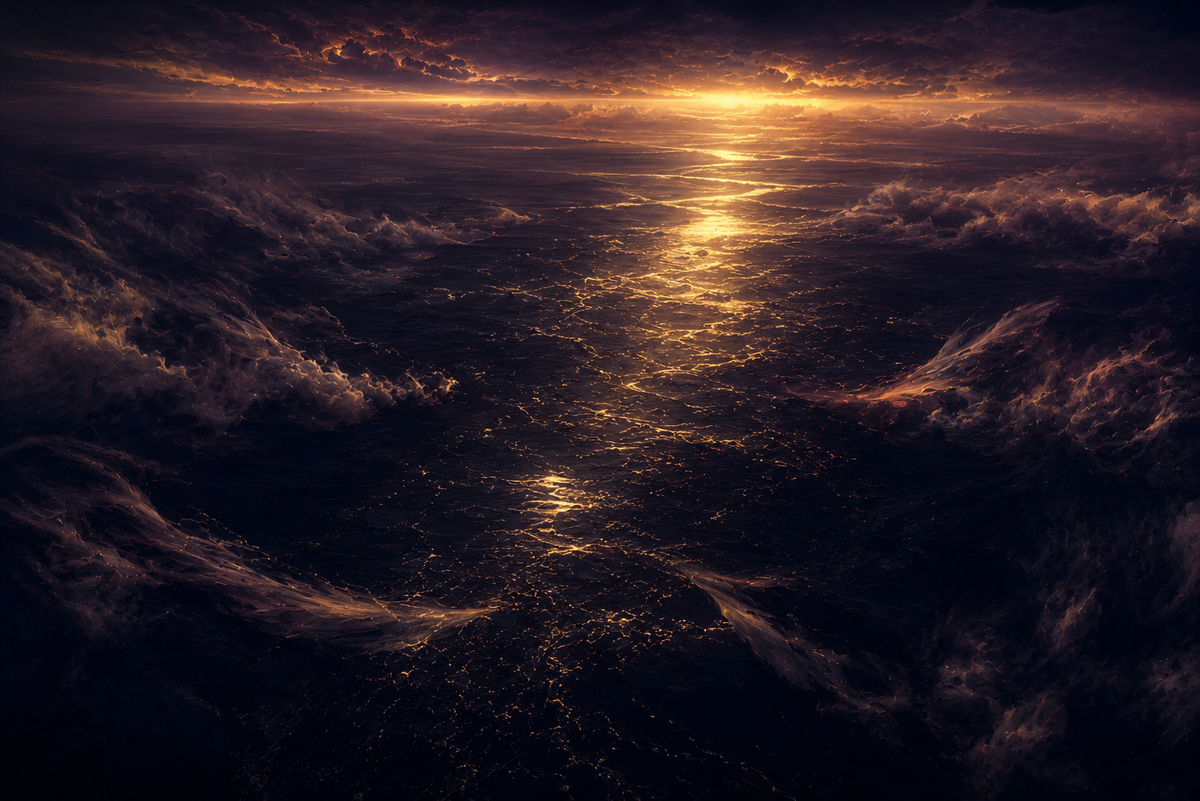
Before anything, there is water.
Not ocean — ocean has a shore, a floor, a far side. This has none of those. No up. No down. No light to tell the difference. The old words for it are tohu wavohu — wild and waste, formless and empty — and over the face of that black water something moves. Hovering. The way a bird hovers over its nest, wings spread, close enough to touch what's beneath it.
The Spirit of God is brooding over the deep.
And then, into a silence that has never once been broken, a voice.
The Story
Let there be light.
That's all. No battle. Every other ancient nation told creation as a war story — their gods hacked sea monsters apart and stretched the corpses into sky, built humans out of spilled divine blood to be slave labor. The oldest audiences of Genesis knew those stories by heart. Which is why this one would have stopped them cold.
No fight. No rival. No effort, even. A voice speaks into the dark, and the dark obeys.
And there is light — and here's the first strange thing this chapter refuses to explain: there is no sun yet. No stars. Light exists for three days before there's a single thing in the sky to carry it. Whatever this light is, it doesn't come from a lamp. The text lets that hang there, unbothered, as if to say: light never belonged to the sun in the first place. It belonged to the voice.
God sees the light, and God calls it good. Then he separates — light from darkness, day from night. Evening comes, morning comes. Day one.
Watch what he's doing, because there's a pattern, and the pattern is the point.
Day two: he speaks a dome into the middle of the waters and splits them — waters above, waters below. The wild deep that swallowed everything gets pushed apart, given borders. Day three: the waters below are herded back until dry land stands up out of them, and the land — at a word — greens. Grass, seed, orchards heavy with fruit. The formless is getting form. Three days of separating, sorting, making space: day from night, sky from sea, sea from land. A house with its rooms framed out.
Then God goes back to the beginning and starts filling the rooms.
Day four fills day one: the light gets carriers now — two great lamps and a spill of stars, hung in the dome to govern day and night. Notice the text won't even name them. Every neighbor Israel had worshiped the sun and moon as gods; Genesis calls them the greater light and the lesser light, like fixtures. Installed. On day six the nations' gods will get demoted further still — but first, day five, which fills day two: the sky gets birds and the seas get swarms, and among the swarms, the text pauses to mention, God created the great sea monsters.
Sit with that. The tanninim — the deep-water dragons that other nations' myths cast as the gods' ancient enemies, the terrors of chaos — show up in Genesis on day five, in a list. Between the fish and the birds. Not fought. Not slain. Made. The monsters under the world's bed turn out to be God's creatures, and he looks at them the way he looks at everything else he's made: good. Then he blesses them. Be fruitful. Multiply. Even the sea dragons get a blessing in this story.
Day six fills day three: the land gets its animals — livestock, crawling things, beasts of the earth, each after its kind. Good, again. The house is framed and furnished, every room full.
And then the rhythm breaks.
Every act so far has begun the same way — let there be, let there be, let there be — a king issuing decrees. Now, for the first time, God speaks like he's leaning in. Like counsel is being taken:
Let us make humanity in our image, after our likeness.
In the world this text was born into, everyone knew what an "image" of a god was. It was a statue. A king would carve his likeness and plant it in a conquered territory so that everyone who passed it knew: this land belongs to that throne. And the image of a god stood in one place only — the innermost room of a temple, where the god was said to live.
So hear what Genesis is claiming. God builds a world — forms it, fills it, lights it — and then places his image inside it. Not a statue. Not one image locked in one shrine, guarded by priests. Living images, walking around. Male and female he creates them, and both are the image; neither one gets it alone. Every human being who will ever draw breath — every ancestor, every stranger, every enemy — planted in the world like a royal claim: this belongs to that throne.
And the images are given the king's own work to do. Be fruitful. Multiply. Fill the earth and subdue it. Rule — over fish and bird and every living thing. God has just spent six days forming and filling; now he hands the forming and filling on. The world is finished but not done — it's a garden expecting growth, a kingdom expecting governors. Humans aren't slave labor built from the blood of a dead god, the way Babylon told it. They're royalty. Junior kings and queens set loose in a very good world with their Father's authority resting on them.
God sees everything he has made. And behold — the text finally lets the seventh good break its banks — very good. Evening comes, morning comes. The sixth day.
Then day seven, and the strangest thing in the chapter.
God rests.
Not because he's tired — the voice that spoke galaxies isn't winded. In the ancient world, "rest" was what a god did when his temple was finished. The building done, the image installed, the god would enter the innermost room and sit down — take up residence, take up rule. Rest wasn't a nap. It was a coronation. A god at rest was a god on his throne, at home, reigning over a world in order.
Genesis has been telling a temple story the whole time. Seven days, like the seven-year builds and seven-day dedications of ancient temples. A cosmos formed and filled like a sanctuary. An image placed in it, last thing, the way an idol was installed in a shrine — except the shrine is the whole world, and the image is us. And now the King takes his seat, and blesses the seventh day, and makes it holy.
One more thing — easy to miss, impossible to unsee.
Every other day closes the same door: evening came, morning came, day one. Day two. Day three. Six times the formula. Then the seventh day arrives — and no evening ever comes.
The day of God's rest doesn't end. The text just leaves it open, like a door standing ajar at the end of a hallway, light coming through the gap. As if the seventh day isn't a day at all but an invitation. As if the whole story so far has been an unfinished sentence, waiting for someone to come and rest with him.
Someone is about to be invited in. That's the next chapter.
The Thread
Everything the Bible does, it does here first. Watch these threads — the whole series will keep pulling them.
The world is a temple. Formed, filled, image installed, God at rest within it. Eden will be its innermost room. When Israel later builds the tabernacle and temple, the builders deliberately echo these seven days — because those buildings are miniature worlds, and this world is one enormous holy place. The Bible's last pages end the same way they open: God dwelling with his people in a temple-city that needs no shrine inside it, because he fills all of it.
Light before sun; word before everything. When John opens his Gospel — In the beginning was the Word — he's rereading this chapter and telling us who was speaking. The voice over the water has a face.
The unfinished seventh day. No evening, no morning. Centuries later, the book of Hebrews will say the door is still open: there remains a Sabbath rest for the people of God. The rest of the Bible is the story of getting humanity through that door.
Image-bearers. Everything Scripture says about human dignity, and every rage it turns on murder and oppression, stands on this: every person you will ever meet is a royal image, planted to mark whose world this is.
Read It Yourself
Genesis 1:1–2:3