What We Learn of Love from Tom Bombadil
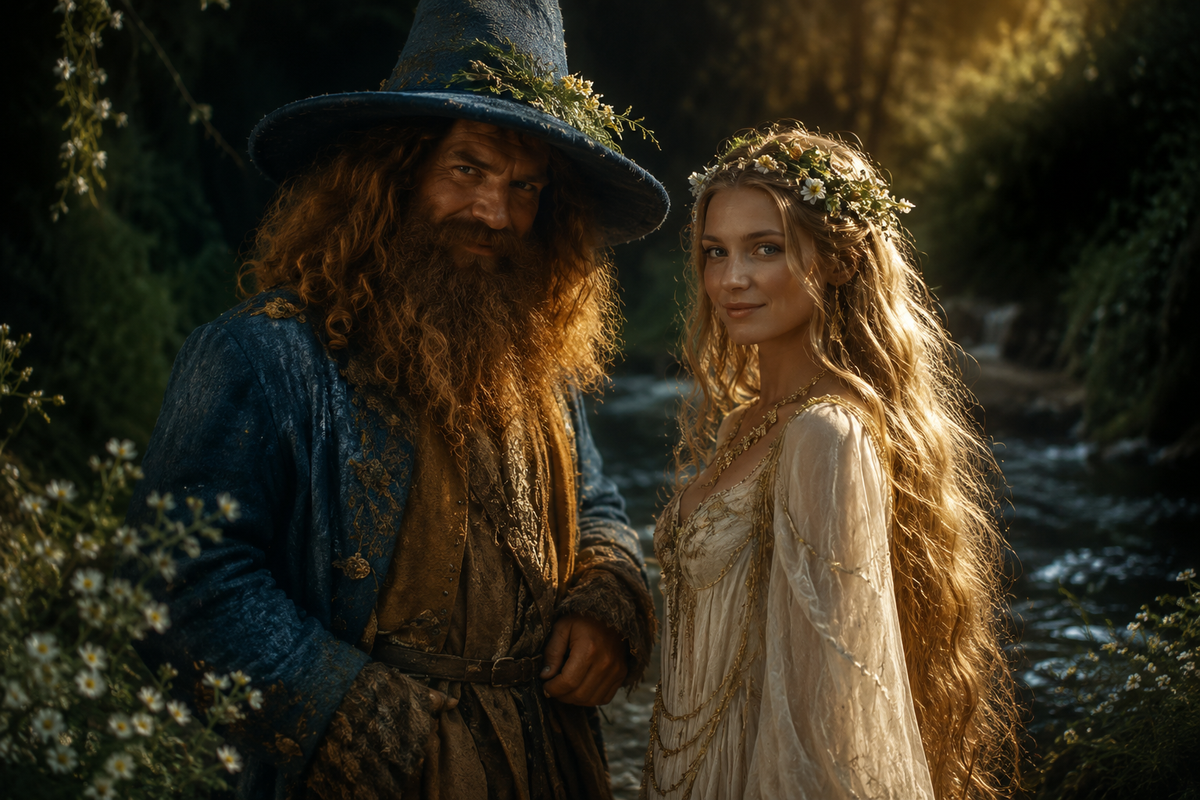
In The Lord of the Rings, Tom Bombadil occupies a few brief chapters and then vanishes from the story, yet he lingers in the imagination far longer than his page count warrants. Critics have long puzzled over his purpose. He is the one figure the One Ring cannot touch — he slips it on and does not disappear, he hands it back without a flicker of desire. If the Ring is Tolkien's emblem of the will to possess and dominate, then Bombadil, immune to it, becomes an emblem of something opposite. He shows us a particular vision of love: love as delight that does not need to own.
The Ring works on its bearers by inflaming the desire to grasp and control. Boromir wants it to defend and command. Gollum is consumed by having it; it becomes his "precious," the whole of his shrunken world. Even Frodo and Galadriel feel its pull toward power. Against all of this, Bombadil is simply unmoved — not because he resists temptation, but because the form of attention he gives to the world has nothing of possession in it. He delights in things without wishing to absorb them into himself. He knows the trees, the river, the badgers, and Goldberry, and he names them and sings to them, but he does not claim them. Gandalf later remarks that the Ring has no power over him because he is his own master in a way no one else is. The love Bombadil models is exactly this: a way of caring for a thing that leaves the thing free.
This is sharpened by his relationship with Goldberry, the River-woman's daughter. Their love is full of joy and play, but conspicuously free of anxiety, jealousy, or the desire to hold. When Frodo, moved, asks Goldberry who Tom is, she answers simply, "He is." She does not define him by his relation to her or by what he owns; she lets him be, fully, and that letting-be is itself the texture of their love. Tolkien gives us a marriage that is not two people completing or absorbing each other but two beings rejoicing in each other's distinct existence.
Bombadil also teaches that this kind of love is bound up with attention and presence. He is endlessly, almost comically present — singing nonsense, stamping in puddles, gathering water-lilies for Goldberry. He is not distracted by the great war of the age; in fact his obliviousness to it is part of why the Council cannot entrust the Ring to him. He would forget it, because his love is given wholly to what is in front of him. There is a moral cost to this, which Tolkien is honest about: pure delight, detached from the world's struggles, cannot save Middle-earth. Bombadil is not a model for how to defeat Sauron. But he is a model for what is being defended — the small, free, joyful life that the war exists to protect.
In the end, what we learn of love from Tom Bombadil is that the opposite of domination is not weakness but delight. The Ring teaches that to love is to want to keep; Bombadil teaches that to love is to let be. He cares for his land and his wife not by possessing them but by knowing them, naming them, and rejoicing that they exist apart from him. It is no accident that this is the one heart the Ring cannot enter. A love with no grasp in it offers the Ring nothing to hold onto.